
PET Fruit Boxes
Clear PET punnets show the fruit and protect it on the shelf. Choose capacity, lid style, venting and stacking around the produce, the pack weight and how the box is displayed.
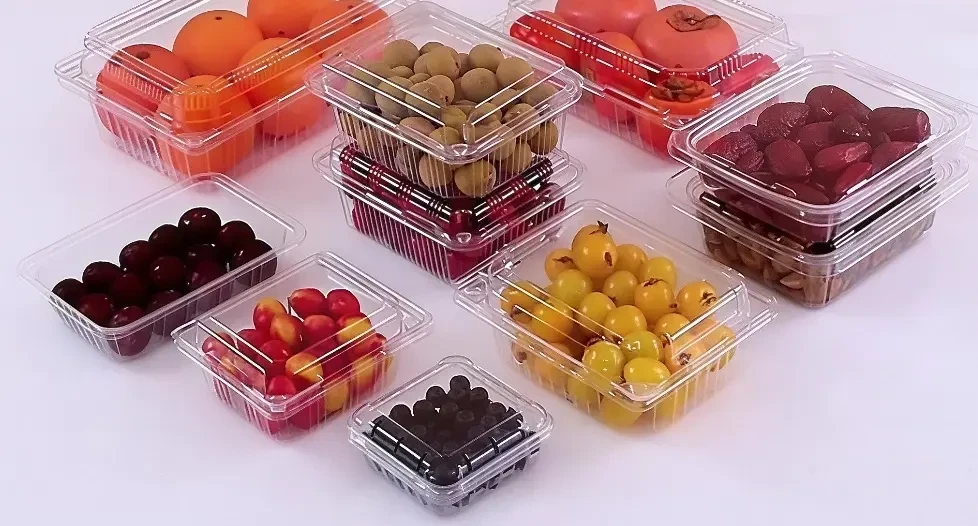
Technical Parameters
| Parameter | Specification |
|---|---|
| Structures | Hinged clamshell, separate lid and base, and lidded tray |
| Material | Food-grade APET or rPET sheet, clear or lightly frosted |
| Sheet thickness | 0.3–0.8 mm, chosen by pack weight and stack height |
| Capacities | 250 g, 500 g and 1 kg standard punnet sizes; custom volumes on request |
| Ventilation | Round or slot vents in the lid and base to reduce condensation |
| Lidding | Snap-fit hinged lid, separate lid or film-sealed tray |
| Packing | Nested in sleeves and cartons, with food-safe liner bags |
Customization process
Six steps from produce to packed cartons, with a filled sample before the tool is made.
- 1
Produce and pack weight
Share the fruit type, average pack weight and stack height so we can propose capacity, wall thickness and base support.
- 2
Structure and venting
Hinged lids close faster on a packing line, separate lids stack flatter; vent position is set where condensation forms most.
- 3
Material choice
Clear APET gives the best visibility, rPET suits recycled-content programmes, and frosted sheet hides minor scuffs in chilled display.
- 4
Tool and sample
A tool is made for the shape, and a sample is filled with your produce to check fit, closure and ventilation before production.
- 5
Printing and labelling
Printing stays on the lid or outer wall, or a label carries variety, origin and barcode information.
- 6
Production and packing
Thermoforming, punching vents and trimming, then nesting in sleeves and cartoning with liner bags for transport.
Where these boxes are used
- Berries, grapes and cherry tomatoes
- Cut fruit and fresh salads
- Supermarket and farm-shop display
- Food-service and catering portions
Product FAQ
Short answers to the questions sourcing teams ask before requesting a quotation.
Which sheet thickness should I choose?
0.3–0.4 mm suits light fruit in small punnets; 0.5–0.6 mm carries grapes and 1 kg packs and keeps the base flat under stack weight; 0.7–0.8 mm is used for deeper trays or chilled display where the lid has to stay rigid.
How do the vents affect condensation?
Vents let moisture escape so condensation does not pool in the base. Position matters more than size: slots in the lid with matching holes in the base let air move through the pack. For fruit that dries out quickly, vent area on the lid is reduced.
How do sampling and lead time work?
A new shape needs a tool before sampling, quoted separately; stock sizes are sampled within a few working days. Production usually takes 12–20 working days after sample approval, and the schedule is confirmed with your order.
How much weight can the boxes carry when stacked?
Stacking capacity depends on sheet thickness and how evenly the punnet is filled: 0.5–0.6 mm punnets normally hold a few layers in a crate, while deeper trays need a support or an agreed maximum layer count. A filled stack is checked on the sample, since uneven fruit and over-filled punnets are the usual cause of a crushed base.
Are the boxes food-grade for direct fruit contact?
Punnets are formed from food-grade APET or rPET sheet and packed in food-safe liner bags, with material declarations supplied with the order. Recycled rPET grades are offered only where the sheet is approved for direct food contact. Print stays on the outside wall or lid, and no adhesive or label sits against the fruit.
How do I manage condensation during chilled display?
Cool the fruit to storage temperature before filling where the process allows, since produce chilled after packing pulls moisture into the box. Vents in the lid paired with base holes let that moisture escape, and punnets are left unwrapped when venting is needed. Shelf life in the display follows the fruit itself: the punnet adds protection and airflow, not extra days.
Can the punnets carry printing or a label?
Printing on punnets is usually kept to one or two colours on the lid, since the fruit is the main visual. Variety, origin, net weight and barcode normally go on a label applied to the lid or end panel, and that label area is reserved in the artwork so the print stays clear of it.
What is the minimum order, and can I mix sizes?
Stock punnet sizes start from a few thousand pieces per size, while custom shapes follow the tool and run length quoted with it. Different capacities can be ordered together, packed and labelled by size, and the mixed order is confirmed by carton count with your order.
Who keeps the forming tool, and how do repeat orders work?
Forming tools are made for your shape and stored under your reference, so a repeat order uses the same tool without a new tooling charge. If a repeat order follows a long gap, the tool is checked and a fresh sample is taken before production, with its condition confirmed at that point.
Can the trays be film-sealed instead of using a lid?
Lidded trays can be replaced by a film-sealed version when your machine seals across the rim: the tray is supplied with a flat sealing flange, and the film is chosen for the pack's moisture and gas needs. Film-sealed trays cannot be reclosed once opened, so they suit single-use portions rather than packs the customer reseals.
How are dimensions confirmed before tooling starts?
Send the product dimensions or a sample pack you already use, and a 2D dimension drawing comes back showing inner capacity, rim width and corner radii for approval. Tooling starts once that drawing is signed off, and the first trial run checks the real capacity and nesting against it.
How is batch consistency checked against the approved sample?
The signed sample is kept as the reference, and each run is checked against it for wall thickness, weight and rim profile. Sheet colour is matched to the reference within the usual lot tolerance, and a production sample is set aside with the run so later deliveries can be compared.
How are the punnets packed for shipping?
Punnets are sleeve-packed or nested in food-safe liner bags, then packed into export cartons marked outside with size and carton count. Nested and flat formats take less space than assembled trays, and carton dimensions are quoted per size so freight can be planned before the order is confirmed.
How are cartons arranged on pallets and in containers?
Cartons are stacked on standard pallets and stretch-wrapped, with cartons per pallet and per container confirmed per size at quotation. Nested punnets load more cartons per pallet than assembled trays, and pallet height is set to match the destination's racking and unloading.
Can I specify a sheet colour or a recycled content share?
Sheet is available clear or in standard tints, and custom colours are matched to a swatch you approve before tooling. Recycled rPET share is quoted as a percentage range per order and stated on the material declaration; a higher recycled share can shift the tint slightly, so the swatch is approved first.
How are samples sent, and which shipping terms do you quote?
Samples go out by courier on the freight account agreed at quotation, with tracking shared once they leave. Bulk orders are quoted FOB by default, with CIF or door delivery quoted on request; the Incoterm, destination port and any destination charges are stated on the quotation.
What payment terms apply, and how is an order confirmed?
A proforma invoice is issued once specification, quantity and Incoterm are agreed, and production is scheduled after the deposit clears. The balance is settled before shipment, and any sample or artwork approval is completed before the run starts.
How are damaged cartons or shortages handled after delivery?
Count cartons against the packing list on arrival and report any shortage, crushed carton or forming defect with photos of the carton label and the affected punnets. The claim is checked against the production sample kept with the run, and replacement or credit on the next order is agreed once the cause is identified.
Are liners or absorbent pads available with the punnets?
Punnets can be supplied with a paper liner or an absorbent pad cut to the base, which holds juice from cut or overripe fruit and keeps it off the lower layer. Both are packed separately so the packing line can add them, and the pad grade is chosen for the fruit's moisture level.
Ready to customize your packaging?
Send dimensions, quantity and artwork notes; our sales team replies with a quotation within one business day.
Specifications follow recognised standards: ISO 9001 quality management, FSC chain of custody, FDA food-contact requirements, SGS test reports. Figures on this page are typical values; final parameters are confirmed against the approved sample and order specification.