
Non-woven Insulated Bags
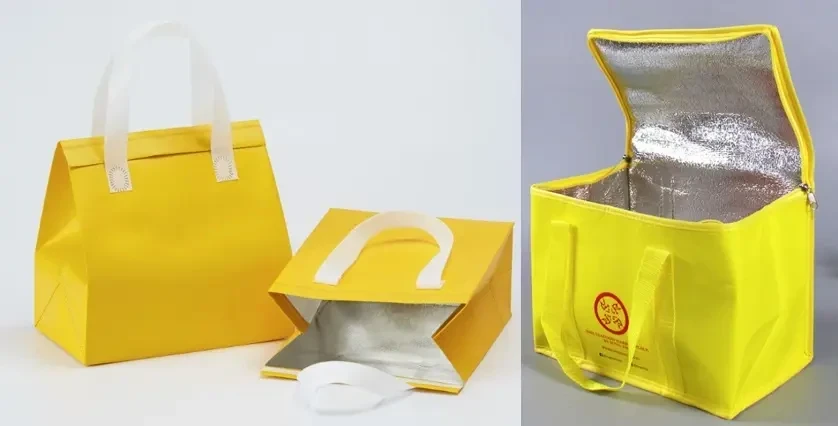
Insulated non-woven bags help takeaway and chilled orders hold their temperature on the way to the customer. Choose size, lining, closure and branding around your delivery route.
Technical Parameters
| Parameter | Specification |
|---|---|
| Construction | Non-woven shell with foil thermal lining and padded walls |
| Fabric | 80–120 gsm laminated non-woven in standard or custom colours |
| Insulation | Aluminium foil lining with foam padding; holding time depends on load and ambient temperature |
| Closure | Zip top, hook-and-loop flap or open top |
| Handles | Stitched non-woven handles with reinforced seams |
| Branding | Screen printing or heat transfer on the front panel |
| Packing | Flat-packed in cartons, grouped by size |
Customization process
Six steps from delivery route to packed cartons, with a plain sample before printing.
- 1
Use and size
Share what goes inside, the typical order size and how far it travels; we propose dimensions, gusset depth and wall padding.
- 2
Fabric and lining
Shell weight and lining are chosen for load and cleaning routine: laminated non-woven wipes clean, and foil lining reflects heat back to the food.
- 3
Closure and handles
Zip tops hold warmth during transport, while hook-and-loop flaps open faster at the counter. Handles are stitched and bar-tacked at the seams.
- 4
Plain sample
An unprinted sample confirms proportions, handle length and zip position before printing starts.
- 5
Artwork proof
A digital proof shows logo size and placement on the flat panel, with Pantone references matched at this stage.
- 6
Production and packing
Cutting, sewing, lining insertion and printing, then flat packing with labels by size.
Where these bags are used
- Bakery, cafe and hot food delivery
- Grocery and chilled goods transport
- Meal-kit and catering orders
- Branded promotions and retail giveaways
Product FAQ
Short answers to the questions sourcing teams ask before requesting a quotation.
Which fabric weight should I choose?
80–90 gsm laminated non-woven suits light orders and short delivery runs; 100–120 gsm holds its shape better for larger bags and repeated handling. Heavier fabric also carries more print coverage without showing through.
How is the insulation built?
The shell is laminated non-woven, followed by foam padding and an aluminium foil lining that reflects heat back to the contents. Zip tops and padded walls reduce air exchange, and holding time depends on load, fill level and ambient temperature.
What is the minimum order quantity and lead time?
Custom sizes usually start from 500 pieces per design, with stock sizes available at lower quantities. Sampling takes around 5–7 working days, and production about 12–20 working days after sample approval, confirmed with your order.
Can these bags be used for chilled or frozen delivery?
Yes. For chilled and frozen orders the foil lining is paired with a thicker foam layer, and an ice pack or gel pack is placed inside; zip tops keep the cold air in. Insulation slows temperature change rather than holding a fixed temperature, so the practical window depends on load, pack-out and ambient conditions, and the combination is checked on your sample.
Ready to customize your packaging?
Send dimensions, quantity and artwork notes; our sales team replies with a quotation within one business day.
Specifications follow recognised standards: ISO 9001 quality management, FSC chain of custody, FDA food-contact requirements, SGS test reports. Figures on this page are typical values; final parameters are confirmed against the approved sample and order specification.