
Non-Woven Bags
Non-woven bags are the reusable carrier many retail and event programs start with: light, printable and sturdy enough for repeat trips. Choose fabric weight, handle style, closure and print around how the bag is handed out and carried.
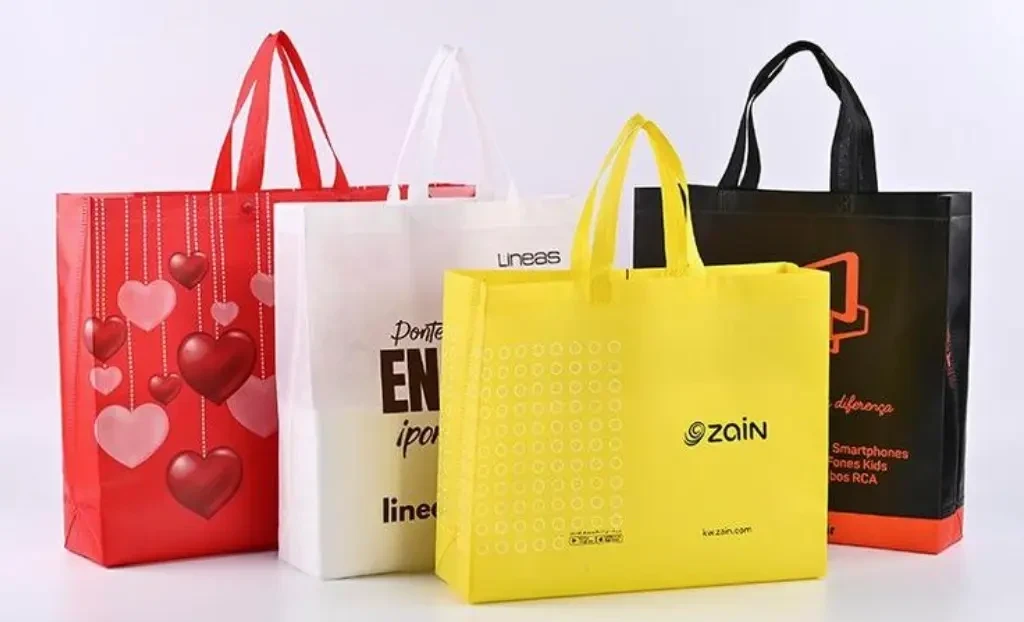
Technical Parameters
| Parameter | Specification |
|---|---|
| Construction | Laminated non-woven bag with sewn or heat-sealed side seams |
| Fabric | 80–100 gsm laminated non-woven, with heavier grades for larger bags |
| Handles | Stitched non-woven, rope or die-cut handles, reinforced at the seams |
| Closure | Open top, magnetic flap or zip; press studs optional |
| Formats | Flat, gusseted or box-bottom, from gift size to grocery size |
| Branding | Screen printing, heat transfer or full-colour laminated print |
| Packing | Flat-packed in cartons, grouped by size and colour |
Customization process
Six steps from giveaway format to packed cartons, with a plain sample before printing.
- 1
Use and format
Share what the bag carries and how it is handed out; we propose a flat, gusseted or box-bottom construction with a base that holds the load.
- 2
Fabric and colour
Weight follows the load and the reuse cycle: 80 gsm suits light giveaway bags, while 100 gsm and above holds shape for groceries and books; colours are matched to a Pantone or fabric swatch.
- 3
Handles and closure
Stitched non-woven handles are standard, rope handles feel softer in the hand, and die-cut handles keep cost down. Magnetic flaps suit gift use, while zip or stud closures add security.
- 4
Plain sample
An unprinted sample confirms size, gusset depth and handle drop before printing screens are made.
- 5
Artwork proof
A digital proof shows logo size and position on the panel, with Pantone references matched and seam allowance kept clear.
- 6
Production and packing
Cutting, printing, sewing or heat sealing, then inspection and flat packing with labels by size and colour.
Where these bags are used
- Retail and boutique purchases
- Trade shows and conference giveaways
- Gift sets and promotional packaging
- Grocery and everyday reusable shopping
Product FAQ
Short answers to the questions sourcing teams ask before requesting a quotation.
Which fabric weight and handle should I choose?
80–90 gsm handles light giveaway bags and single-item purchases, while 100 gsm and above holds its shape for grocery loads and repeated use. Stitched non-woven handles are the most economical, rope handles feel softer in the hand, and die-cut handles suit low-cost promotions.
Can the bag be printed all over?
Laminated non-woven takes full-colour print across the whole panel, while screen printing is usually limited to one or two colours. Artwork is checked against the seam and handle positions, and a proof confirms how much of the panel the logo covers.
What is the minimum order and lead time?
Custom sizes usually start from 500 pieces per design, with stock sizes available at lower quantities. Sampling takes about 5–7 working days, and production about 12–20 working days after sample approval, confirmed with your order.
Are non-woven bags reusable, and how should they be cleaned?
Laminated non-woven wipes clean with a damp cloth and is built for repeat trips, which is why it is common for retail and event bags. It is not machine washable, and print life depends on abrasion during use; heavier fabric and stitched handles extend the working life.
Can the bag have a magnetic flap, and how is the print applied?
A magnetic flap is sewn between the shell and the lining, so the magnets stay hidden and the flap closes flat; two magnets are usual on grocery sizes. Logos are screen printed directly on the panel or applied as heat transfer, and the print area is kept inside the seam and handle positions.
What is the difference between laminated and plain non-woven?
Laminated non-woven has a thin film fused to the fabric, which makes the surface water-resistant and lets full-colour print read sharply. Plain non-woven is softer, more breathable and usually lower in cost, and it suits screen-printed logos on short-use bags; laminated bags wipe clean, so they are the usual choice for grocery and event bags.
How many print colours can I use, and how are spot colours matched?
Screen printing is usually quoted at one or two colours per side, since each colour adds a screen and a print pass. Pantone references are matched on the fabric rather than on paper, and a printed sample on the actual non-woven shade is approved before the run; full-colour artwork is better suited to laminated bags.
Which file format and bleed do you need for bag printing?
Artwork is preferred as a vector PDF, AI or EPS with text converted to outlines, and any placed image at 300 dpi or above. Because bags are cut and sewn, files carry about 3 mm bleed beyond the trim and the logo stays inside the seam allowance; a PDF proof shows print position on each panel.
Can the bag be paired with a card base or liner for gift sets?
Bags can be supplied with a printed card base or a board insert cut to the bag footprint, so the gift sits level and the bag keeps its shape once opened. Card and bag are printed together for colour matching, and insert thickness follows the weight of the contents.
How is handle length set, and are the bags load-tested?
Handle drop is set against how the bag is carried: around 20–25 cm for hand carry and longer for shoulder use, measured from the top edge. Handle seams are bar-tacked, and a test load is checked on the sample against the fabric weight and the contents you expect to pack.
Ready to customize your packaging?
Send dimensions, quantity and artwork notes; our sales team replies with a quotation within one business day.
Specifications follow recognised standards: ISO 9001 quality management, FSC chain of custody, FDA food-contact requirements, SGS test reports. Figures on this page are typical values; final parameters are confirmed against the approved sample and order specification.